

Some organizations have developed thoughtful systems that help patients receive consistent support throughout the cancer experience. Others have excellent clinicians, valuable resources, and specialist expertise, but those pieces have evolved independently over time and don’t always connect in ways that are easy for patients or staff to navigate.
When one looks closely it’s easy to see that the quality of an organization’s intimacy-informed care has less to do with whether any one program exists than with how well many small parts of the system work together.
That observation became the foundation for CancerEVOLVE.
Every organization has a way of addressing intimacy-related care, whether it’s intentional or not.
Looking through a different lens
When we begin working with an organization, we’re usually less interested in asking what is missing than in understanding what already exists.
The questions we use to guide our inquiry are questions like these::
✔️ Where are conversations already happening?
✔️ How do patients find support?
✔️ What happens after someone asks for help?
✔️ What expectations do staff carry into these conversations?
✔️ How visible are the available resources?
✔️ Where does the system feel connected, and where does it rely on individuals to bridge the gaps?
These questions rarely produce simple answers. They do, however, reveal patterns.
Those patterns eventually became the six domains of CancerEVOLVE.
The six domains that shape the patient experience
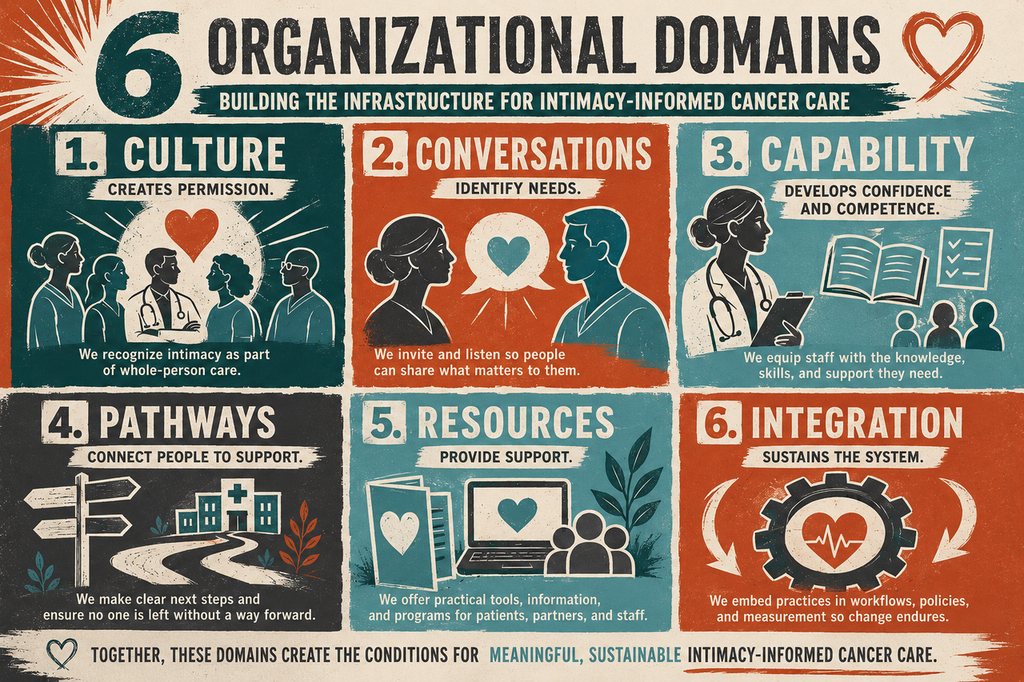
These six domains are not six departments, six professions, or six programs.
They are six aspects of an organization that holistically influence whether intimacy-informed care becomes a consistent part of the patient experience.
Culture
What messages tell patients and staff that intimacy is a legitimate part of cancer care at your organization?
Related Reading:
Conversations
When, where, and how do these conversations naturally occur? Or must patients bring them up?
Related Reading:
Capability
Do team members feel prepared to respond and support within the scope of their role?
Related Reading:
Pathways
If a patient, survivor or partner needs additional support, is the next step clear?
Related Reading:
Resources
Are useful resources routinely shared with patients, or simply available if someone knows where to look?
Related Reading:
Integration
Has this become part of how the organization works, or does it still depend on a few committed individuals?
Related Reading:
Continue Exploring
Having the Pieces Isn’t the Same as Having the System
Many organizations already have excellent resources, specialist services, and dedicated professionals. Why, then, do patients still experience gaps in care? This article explores the difference between strengthening individual programs and strengthening the system that connects them.
Matching the level of care to the need
Many intimacy-related concerns don’t require specialist care. Often, patients simply need an opportunity to talk, useful information, or guidance about what to do next. More focused support is there when it’s needed.
The Five Levels of Care grew from a simple idea: not every concern requires the same level of expertise, but every concern deserves an appropriate response.

Rather than asking whether a conversation should happen, the Five Levels ask a different question:
What is the most appropriate response for this person, at this point in their cancer experience?
Continue Exploring
Why One Conversation Is Rarely Enough
Needs change over time. This article explores why timing matters and why routine inquiry often become one of the defining characteristics of intimacy-informed care.
Seeing the whole picture
Intimacy-informed care is shaped by more than any single resource, conversation, training, or referral pathway. It depends on how different parts of the organization work together and on the level of support a patient needs at a particular moment.
The CancerEVOLVE Framework brings these dimensions together. It looks across six organizational domains and five levels of care to show both what needs to be in place and how support can range from simple acknowledgment and first-line guidance to more specialized care.
Together, the domains and levels of care provide a way to see what is already working, where connections may be missing, and where focused changes could strengthen the quality and consistency of an organization’s care.

Continue Exploring
Why Every Organization Starts in a Different Place
Improvement rarely begins by adding something new. More often, it begins by seeing existing strengths and gaps with greater clarity.
What does this look like in your organization?
A framework, by itself, doesn’t change an organization. People do.
The CancerEVOLVE Framework gives you a way to look at how intimacy-informed care is taking shape across your organization. From there, you can begin to see what’s working well and where there may be room to strengthen support.
Are there practices that are already working well? Does support sometimes depend on who a patient happens to talk with? Are helpful resources reaching the people who need them? Do staff know how to respond, how to access resources, or where to turn when more support is needed?
Our no-cost Organizational Readiness Snapshot helps you take a closer look at these questions and get a clearer sense of where your organization stands and what might be worth focusing on next.
Ready to put something concrete in place? → EXPLORE OUR IMPLEMENTATION SUPPORT